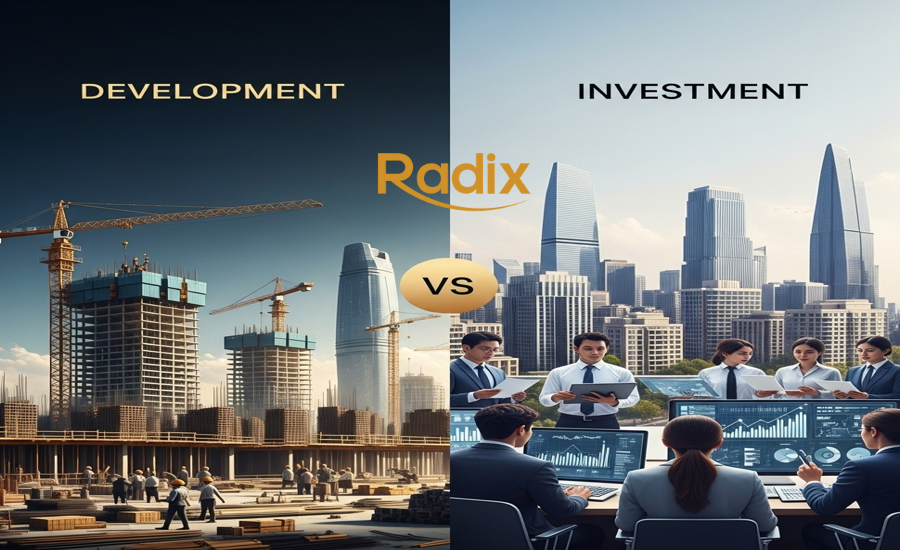
Real Estate Development vs. Investment in Egypt: Capital, Risk & ROI Compared
Egypt's property sector—spanning master-planned smart cities in the New Administrative Capital and infill residential plots in New Cairo's Beit Al Watan—offers two distinct avenues for capital deployment: active Real Estate Development and passive/semi-passive Real Estate Investment. While both participate in the same urban value chain, they differ fundamentally in capital scale, licensing complexity, construction risk exposure, and profit structure.
Two Different Paths
Understanding whether your capital and expertise belong on the development side (creating new square meterage from raw land) or the investment side (acquiring individual or bulk units for rental yield and resale appreciation) prevents costly missteps.
What Is Real Estate Development?
Real estate development is an active industrial and operational business that transforms raw land into completed residential, commercial, or administrative buildings. In Egypt, a developer bids for land allocations from authorities such as NUCA or ACUD (or enters a revenue-share joint venture with a landowner), secures the Ministerial Decree (القرار الوزاري) and building permits, finances infrastructure and excavation, manages structural and MEP contractors through volatile material-cost cycles, markets off-plan units on 6-to-10-year payment schedules, and operates post-handover facility management.
Learn more about Best Types of Real Estate Investment
What Is Real Estate Investment?
Real estate investment focuses on acquiring titled built or off-plan units—such as apartments, retail shops, offices, or medical clinics—or subscribing to regulated real estate funds to generate recurring rental income and long-term capital appreciation. Unlike the developer, the investor transfers construction execution and licensing administration to the development company while locking in a fixed contract price.
Different Goals and Purposes
• Development Objective (Value Creation & Margin): Aims to manufacture new real estate inventory and capture a 20%–35%+ gross development margin over a 3-to-6-year project cycle—while bearing full construction-cost inflation, contractor default, and cash-flow collection risks.
• Investment Objective (Yield & Wealth Compounding): Aims to preserve capital and generate 7%–13.5%+ annual rental yields alongside compounded equity growth without managing engineering crews or regulatory permits.
Take a closer look at The Difference Between Real Estate Development and Real Estate Investment
Key Tasks of a Developer
• Market Analysis & Feasibility: Modeling land cost, construction replacement budgets, off-plan sales velocity, and financing gaps.
• Execution Planning & Engineering Design: Appointing architectural and MEP consultants (such as IEC and MRB) to optimize floor plates and net-to-gross loading ratios.
• Legal Compliance & Licensing: Securing Ministerial Decrees, civil defense approvals, and environmental clearances.
• Project Supervision & Cost Control: Hedging steel, cement, and imported MEP procurement to deliver on schedule.
• Marketing & Post-Delivery Facility Management: Managing sales advisory and partnering with FM operators (such as Mowafak) to sustain long-term community value.
Key Tasks of an Investor
• Sub-Market Research: Comparing district absorption, infrastructure readiness, and price per net usable square meter.
• Asset Selection & Developer Audit: Selecting the right unit type (residential vs. retail/office) with a developer that has a proven delivery track record.
• Financial Valuation: Calculating total acquisition cost, installment NPV, and net rental yield after maintenance deposits.
• Leasing & Portfolio Management: Securing creditworthy corporate or family tenants and structuring 10% annual rent escalation clauses.
If–Then Decision Framework: Should You Develop a Plot or Invest in Ready/Off-Plan Units in Egypt?
• IF you have EGP 3M to EGP 30M and want predictable wealth building without construction headaches → Choose Direct Unit Investment: Acquire a diversified mix of residential and commercial/administrative units with a tier-one developer on a 6-to-8-year fixed installment plan.
• IF you are considering buying a small single-plot land parcel in Beit Al Watan or New Cairo to build a mini-building yourself → Beware of Unhedged Construction Risk: Small individual builders face retail material prices (steel, cement, cables) without bulk contractor discounts, often resulting in budget overruns that erase the development margin.
• IF you hold institutional capital (EGP 100M+) and want development-level returns without operational execution → Consider Co-Investment or Bulk Floor Acquisition in prime NAC/New Cairo commercial towers at early-launch wholesale discounts.
For practical steps, check out Real Estate vs. Stocks: Which Investment Wins?