The Future of Commercial Real Estate Investment in Egypt
Commercial real estate in Egypt is evolving alongside the expansion of new cities, the development of business districts, and the growing need for modern spaces where companies can operate and serve customers. For investors, these changes create opportunities across administrative offices, retail units, and mixed-use developments. However, understanding where demand is emerging and how businesses choose their locations is essential before making an investment decision.
How Smart Business Districts Are Transforming Commercial Investment
Modern business districts are changing how companies select office spaces and how investors evaluate commercial properties. Rather than relying solely on a central location, businesses increasingly consider accessibility, infrastructure, nearby services, parking, and the overall working environment.
Smart business districts can bring different commercial activities closer together, supporting interaction between offices, retail outlets, and service providers. This concentration can make an area more attractive to businesses seeking convenient locations for employees and customers.
Investors assessing these developments should examine:
- The range of businesses expected to operate nearby.
- Access to major roads and public transportation.
- Availability of essential services and parking.
- The project's design, facilities, and management arrangements.
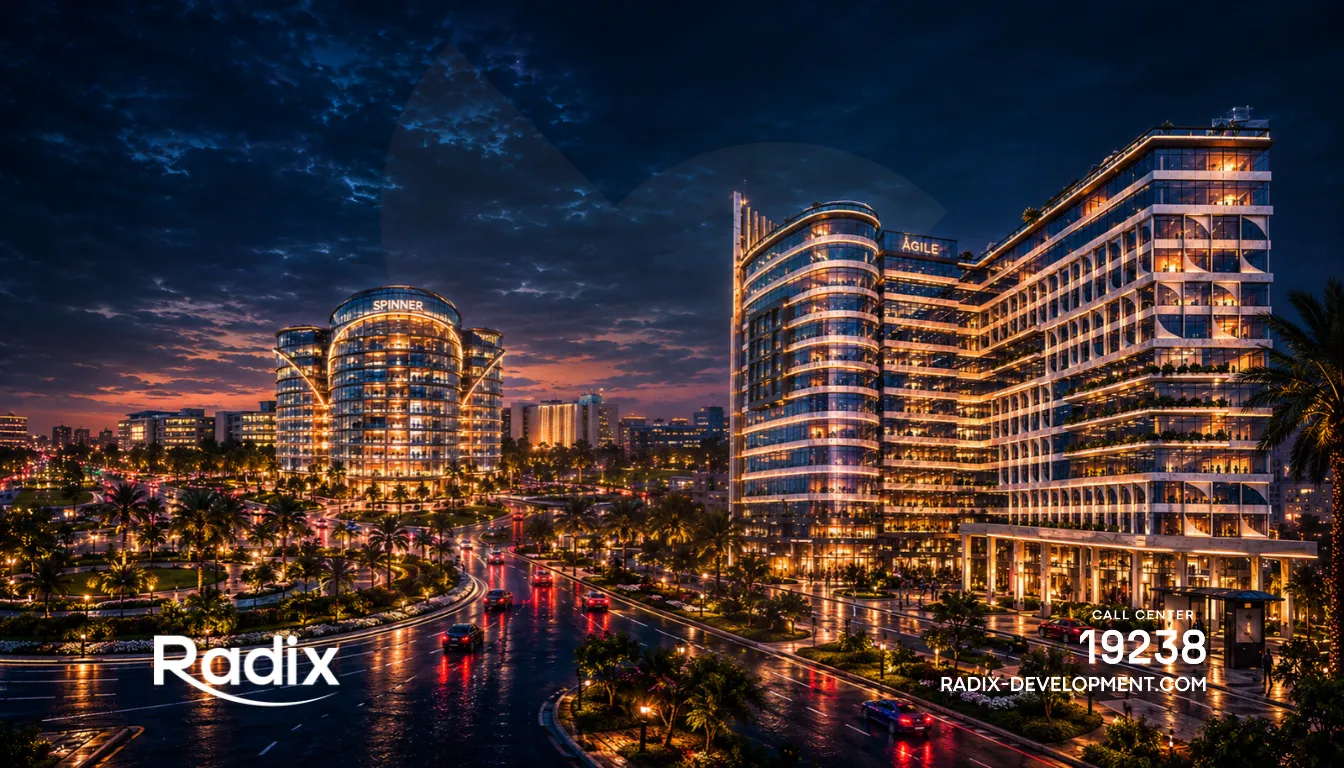
Projects such as Radix Development's Agile Business Complex in Downtown, New Administrative Capital, reflect the development of dedicated commercial and administrative destinations. Investors should assess each project's specifications, delivery status, and surrounding business activity before estimating its potential performance.
Market Trends Driving Future Demand
Commercial property demand is influenced by business expansion, changing workplace practices, population movement, and the growth of new economic centers. Companies may seek modern offices that accommodate employees, support collaboration, and provide convenient access to clients. Retail businesses, meanwhile, depend on customer accessibility, visibility, and the purchasing activity of the surrounding population.
These trends affect property types differently. Administrative offices may appeal to companies seeking professional workspaces, while retail units depend heavily on location-specific consumer demand. Mixed-use developments can offer a combination of activities, but their performance still depends on the needs of the businesses and residents they serve.
Before investing, consider:
- Business demand: Which industries are establishing or expanding operations in the area?
- Tenant requirements: What sizes, facilities, and layouts do prospective tenants need?
- Competitive supply: How many comparable units are available or under development?
- Leasing conditions: What rental rates and occupancy periods are supported by market evidence?
Understanding these factors helps investors distinguish between actual commercial demand and expectations based mainly on future growth.
The Impact of Infrastructure on Commercial Growth
Infrastructure plays an important role in determining whether a commercial location is practical for businesses and accessible to customers. Road connections, transportation networks, utilities, telecommunications, and nearby public facilities can influence how easily people reach a development and how efficiently companies operate.
The New Administrative Capital illustrates how urban planning and infrastructure development can shape commercial investment opportunities. Its business districts are designed to accommodate administrative and commercial activities, while connectivity between districts and surrounding areas remains an important consideration for businesses evaluating locations.
However, infrastructure announcements do not automatically translate into immediate rental demand. Investors should distinguish between completed facilities and projects that remain under construction or are planned for the future.
Useful checks include:
- Confirming which roads and transportation links are operational.
- Evaluating travel times from residential areas and employment centers.
- Checking the reliability of utilities and digital connectivity.
- Reviewing construction timelines and the accessibility of the immediate surroundings.
These details help investors assess whether a property can meet current business needs as well as anticipated future requirements.
Emerging Opportunities Across New Cities
Egypt's new urban communities are creating additional locations for commercial development beyond established city centers. As residential neighborhoods, government facilities, and business destinations expand, demand may emerge for offices, retail services, clinics, and other commercial activities.
The opportunity, however, varies by district and property type. A retail unit may require strong pedestrian movement and a substantial nearby customer base, while an administrative office may depend more on corporate tenants, transportation access, and suitable facilities.
Radix Development's Spinner New Capital, located in the MU23 area, includes commercial and administrative units. When reviewing developments of this kind, investors should compare unit size, purchase costs, payment terms, project delivery information, and the level of existing commercial activity.
New-city investment research should also address:
- The current population and occupancy of nearby residential communities.
- The number and type of businesses already operating locally.
- Competing commercial projects and their available units.
- The timeline for infrastructure and surrounding development.
Building Resilient Commercial Investment Strategies
A resilient investment strategy balances potential returns with the costs, risks, and practical requirements of owning commercial property. Instead of relying on projected price increases alone, investors should examine how a property could perform under different occupancy and rental scenarios.
A practical evaluation should cover the full financial picture, including the purchase price, maintenance, service charges, taxes where applicable, financing costs, fit-out requirements, and potential vacancy periods. Rental income should be estimated using comparable properties and realistic leasing assumptions rather than advertised figures alone.
Investors can strengthen their approach by:
- Comparing several developments using the same financial criteria.
- Reviewing the developer's track record and contractual obligations.
- Checking ownership documents, permitted uses, and delivery commitments.
- Estimating net rental income after recurring expenses.
- Maintaining a financial reserve for vacancies and unexpected costs.
- Avoiding excessive concentration in one property type or location.
Preparing for the Next Generation of Business Developments
Future commercial developments will need to respond to changing business requirements, including digital connectivity, flexible layouts, energy efficiency, accessible facilities, and convenient services. These features may influence a property's long-term suitability, although their value depends on tenant demand and the quality of implementation.
Investors evaluating upcoming projects should look beyond architectural concepts and marketing materials. They should review the specifications in the contract, expected operating costs, facilities management, and the practical flexibility of the unit.
Key questions include:
- Can the space accommodate different business activities within its permitted use?
- Are internet infrastructure, utilities, and essential services adequate?
- Will the layout remain practical as tenant requirements change?
- Are maintenance responsibilities and service charges clearly documented?
- Does the projected investment return remain reasonable under conservative assumptions?
Answering these questions helps investors evaluate whether a commercial property is equipped to meet evolving business needs without relying solely on optimistic growth projections.