The Most Profitable Property Types for Real Estate Investors in Egypt
Egypt’s real estate market offers investors a wide range of opportunities across residential, commercial, administrative, and mixed-use developments. With growing demand for housing, business spaces, healthcare facilities, and integrated communities, choosing the right property type has become an essential part of building a successful investment strategy.
The most profitable property type is not necessarily the one with the highest expected return. Investors should consider factors such as location, demand, project quality, developer reputation, rental potential, resale opportunities, and the long-term development of the surrounding area.
Residential Properties for Sustainable Growth
Residential real estate remains one of the most established investment options in Egypt, particularly in strategically planned cities and emerging urban destinations. Apartments and other residential units can provide investors with opportunities for both capital appreciation and rental income.
Residential properties can be particularly attractive when they are located within well-planned communities that offer essential services and convenient access to major roads, business districts, educational institutions, and recreational facilities.
Key factors to consider include:
- Strong and sustainable demand for residential units.
- Strategic project locations within established or emerging communities.
- Quality of construction and residential design.
- Availability of integrated facilities and lifestyle services.
- Potential for long-term capital appreciation.
Commercial Properties That Generate Higher Income
Commercial real estate represents another important category for investors seeking income-generating assets. Retail units can benefit from continuous consumer activity, especially when located within developments that attract residents, employees, visitors, and businesses.
The success of a commercial investment depends heavily on visibility, accessibility, surrounding population density, tenant demand, and the overall quality of the development.
Investors should evaluate:
- Foot traffic and accessibility.
- The strength of the surrounding commercial market.
- The diversity of potential tenants.
- Project visibility and architectural planning.
- Long-term demand for retail and service businesses.
Administrative Offices as a Growing Investment Sector
Administrative properties have become increasingly important as Egypt continues to expand its business infrastructure. New urban centers are attracting companies, entrepreneurs, professional services, and corporate activities, creating demand for modern office environments.
Administrative units can provide investors with flexible opportunities, particularly when projects are positioned near major business hubs and transportation networks.
A strong administrative investment typically offers:
- Access to established business districts.
- Modern facilities suitable for different companies.
- Flexible spaces for professional activities.
- Strong demand from businesses and service providers.
- Potential for rental and resale opportunities.
Radix Developments: Combining Residential and Commercial Opportunities
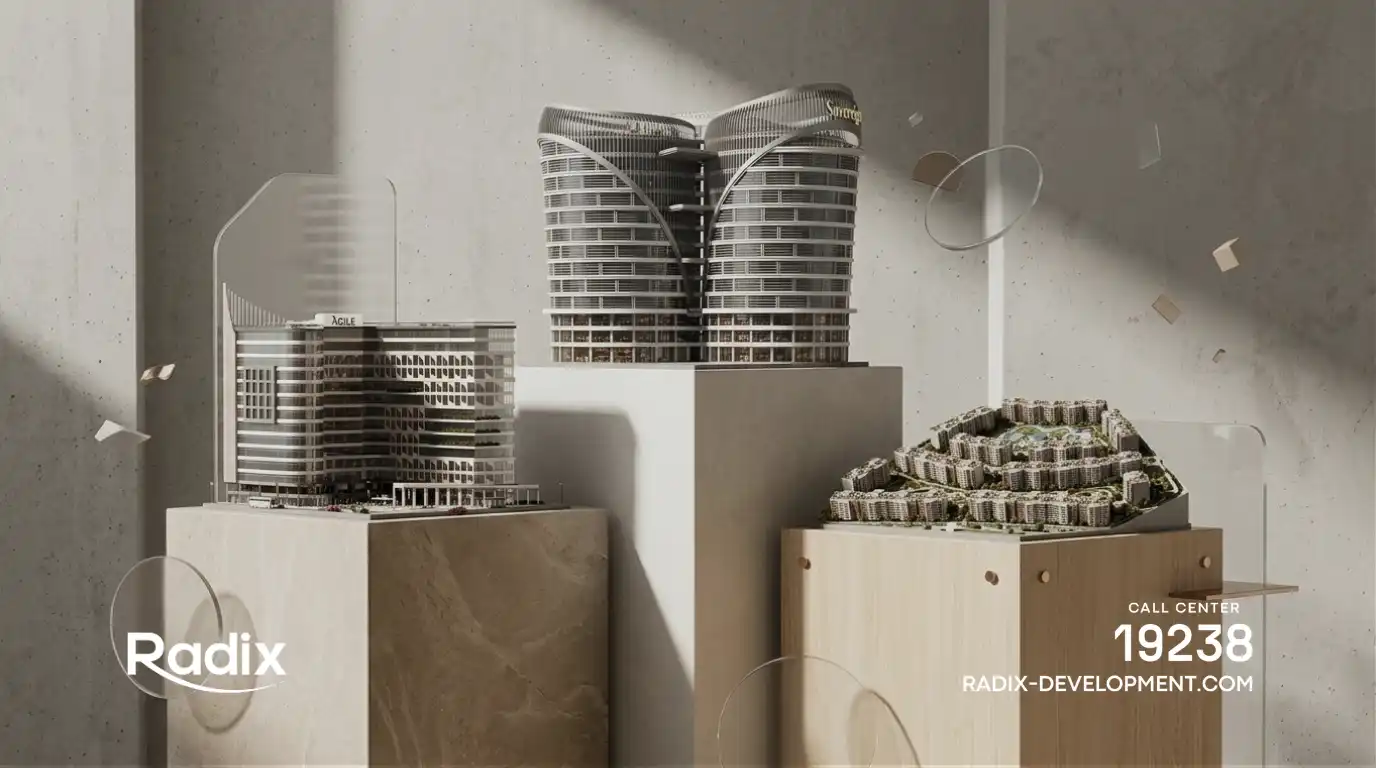
For investors exploring different profitable property types in Egypt, Radix Developments offers examples of how residential, commercial, administrative, and medical assets can be integrated into strategically located projects.
One notable development is Spinner Mall New Capital, located in the MU23 area of the New Administrative Capital. The project combines commercial, administrative, and medical spaces, creating a diversified investment environment designed to serve different business activities.
Its location and multi-purpose concept highlight an important investment principle: mixed-use projects can benefit from several sources of demand rather than relying on a single property category.
Another Radix project is Radix Agile Mall New Capital, located in the Downtown area. The development combines commercial, administrative, and medical activities within a large-scale project overlooking green areas and a central park. This combination can provide investors with exposure to several segments of the growing business and services market.
On the residential side, Ray Residence New Capital represents Radix’s approach to residential investment. Located in the R8 district, the development provides residential units within a planned community supported by lifestyle-oriented facilities and services.
Together, these projects demonstrate how investors can diversify across different property types while considering location, project quality, and future demand.
Mixed-Use Developments and Their Investment Advantages
Mixed-use developments have become increasingly attractive because they bring residential, commercial, administrative, and sometimes medical activities into a single integrated environment.
This model can create a self-sustaining ecosystem in which residents generate demand for retail and services, while businesses benefit from nearby customers and employees.
The main advantages include:
- Multiple sources of potential demand.
- Greater activity throughout different times of the day.
- Convenient access to services and facilities.
- Opportunities for diversified real estate portfolios.
- Potentially stronger resilience compared with single-use developments.
Mixed-use projects can therefore be particularly suitable for investors seeking diversification within the same development or across several asset classes.
Choosing the Right Asset Based on Your Budget
Selecting the right property should begin with the investor’s financial capacity and investment objectives rather than focusing solely on the property category.
Residential units may appeal to investors seeking long-term demand and potential rental income, while commercial properties can suit investors targeting business-driven demand. Administrative units may offer opportunities linked to the expansion of Egypt’s corporate sector, while mixed-use developments can provide broader diversification.
Investors should consider:
- Available investment capital.
- Expected holding period.
- Target rental strategy.
- Desired level of diversification.
- Liquidity and potential resale demand.
- Long-term development plans for the location.
Matching Property Types to Your Investment Strategy
There is no single property type that is ideal for every investor. The best choice depends on individual objectives, risk tolerance, investment horizon, and understanding of the local market.
Residential properties can support long-term wealth building, commercial assets can target income-generating opportunities, and administrative properties can benefit from business expansion. Mixed-use developments, meanwhile, allow investors to participate in several market segments through integrated projects.
Ultimately, successful real estate investing in Egypt requires looking beyond the unit itself. Location, developer reputation, infrastructure, project quality, surrounding demand, and future urban growth all play an important role in determining an asset’s investment potential.
By comparing different profitable property types in Egypt and aligning them with a clear investment strategy, investors can make more informed decisions and build diversified real estate portfolios designed for long-term growth.